J & R Forestry, Inc.
2721 Maytown Rd, Marietta, PA 17547
Ph: 717-341-4414 Email:gvspray@gmail.com
Forestry Herbiciding
Understory herbiciding for tomorrow’s
regeneration needs.
___________________________________________________________________________________
Our mission is to work with foresters and natural resource professionals, state agencies, large land holders, private individuals, on a personal, one-to-one basis, to control undesirable vegetation, and to improve natural regeneration of forests.
___________________________________________________________________________________
What is understory herbiciding?
Understory Herbiciding is a controlled burn down using chemicals to kill or control undesirable vegetation
within 15 feet of the forest floor.


Although the process of applying forestry chemicals is all the same the absorption of the chemicals into the plant system works 2 different ways:


n Residual Herbicides rely on rain to transfer the chemical into the soil where they are absorbed by the plant through the root system.
_________________________________________________________________________________________________________
We apply three types of treatment:
Non-Selective Contact Herbicides

This treatment is exactly what it sounds like. All of the vegetation, including the woody and soft tissue, is targeted using specific herbicides. The chemicals are applied to the foliage, absorbed and trans-located to the root systems, killing the plant. In this type of treatment we need a three hour rain free period after application for the chemical to lock itself on to the foliage. This is by far, the most prevalent type of application that we use.
Selective Contact Herbicide
In this treatment we use Sulfometuron Methyl, commonly known as Oust® or Spyder. This chemical is applied the same way as our non-selective, broadcast by airblast, but this chemical targets only soft tissue material and is used when adequate regeneration (woody material) is present under fern, grasses, mile-a-minute.
Selective Residual Herbicides
In this type of treatment the chemical we use Sulfometuron Methyl, commonly known as Oust® or Spyder. It is applied in the same manner as our other chemicals, by air-blast, but when the foliage is dormant (early spring – March or April) and relies on rain to transfer the chemical into the soil where is absorbs through the root system.
This chemical targets soft tissue plants. This treatment is used when adequate regeneration (woody material) is established under fern, grasses or mile-a-minute.
Although this is our least common application the benefits of this are that it works best on mile-a-minute and allows to start earlier in the season.
_______________________________________________________
Frequently asked herbiciding questions
When is a herbicide application warranted?
Herbicide applications are associated with timber harvests that are designed to promote regeneration. If a timber harvest area has more than 40 – 50 % competitive ground cover, then herbiciding is a very effective way to eliminate the ground cover that will compete with regeneration.


Before and after photos from the same spot.


Before and after photos from the same spot. This area was logged, allowed to grow for one year then herbicided.
It was planted in pines the following spring.
What types of vegetation can be controlled?
With the proper herbicide application, ferns, beech brush, striped maple, spice bush, multiflora rose, mountain laurel, grasses and other species can be effectively controlled.
What herbicide products do we most commonly use in the forest industry?
n Round-up® - Glyphosate – 53%
n Oust® - Sulfometuron Methyl
n Arsenal
n Garlon 3-A
When is the best time to spray?
Depending on your location, the spray season runs from early June through mid-September or until frost. Fern, beech brush, and multiflora rose can be effectively controlled when full leaf out has occurred. Better results for striped maple will be achieved if not sprayed until August or September.
Should we spray before or after the timber harvest?
Many factors weigh in this decision, which are:
n Harvest schedule
n Type of harvest
n Terrain
n Vegetation to be controlled
n Seed source
n Pine Plantation
How soon after the herbicide application should we see results?
Herbaceous material (soft tissue) it takes 4 – 6 weeks to see the full effect. With woody material, it generally takes one full growing season.
How long must we stay out of the application site?
12 – 48 hours, depending on the products used.
How soon may timber harvest begin after a herbicide application?
A minimum of 4 weeks and if schedule permits, 8 weeks.
How much vegetation control can we expect and how much is enough?
Generally, we achieve a 90 – 100% kill. The more control we have, the bigger the window for regeneration is. However, it is not necessary to have a complete kill to have successful regeneration. 80% kill is satisfactory.
How long will the herbicide treatment remain effective?
If you have achieved an 80% or better kill, your herbicide treatment should remain effective 4 – 5 years. There are other tools that can be used to extend that window, such as deer fencing.
Who ever thought of this idea and how did we get into the business?
Agriculture has been effectively using chemicals since the 60’s to produce better crops.
Alleghany Research Station saw the need to try to chemically control vegetation and they started to experiment with it in the late 80’s. The results were very promising.
One problem – these sprayers are not commercially produced. All these machines have to be hand built and fitted to the carrier that you are using.
Being that I have experience in agriculture herbiciding and that I was also involved in the logging industry, I combined the two when I saw the need arise.

In 1995 we started herbiciding with a rubber-tired machine using one of the sprayers that Alleghany National Forest started experimenting with.

Although the sprayer was adequate, the carrying vehicle was limited to traversing flat to medium sloped terrain.
In 2002, the industry was quickly evolving and the need to cover steep and rough terrain was an issue that we had to deal with. We bought a KMC track machine that was fitted as a grapple skidder. Having 6 seasons under our belt allowed us to have the “hands on” experience enabling us to know what we wanted in our next sprayer.

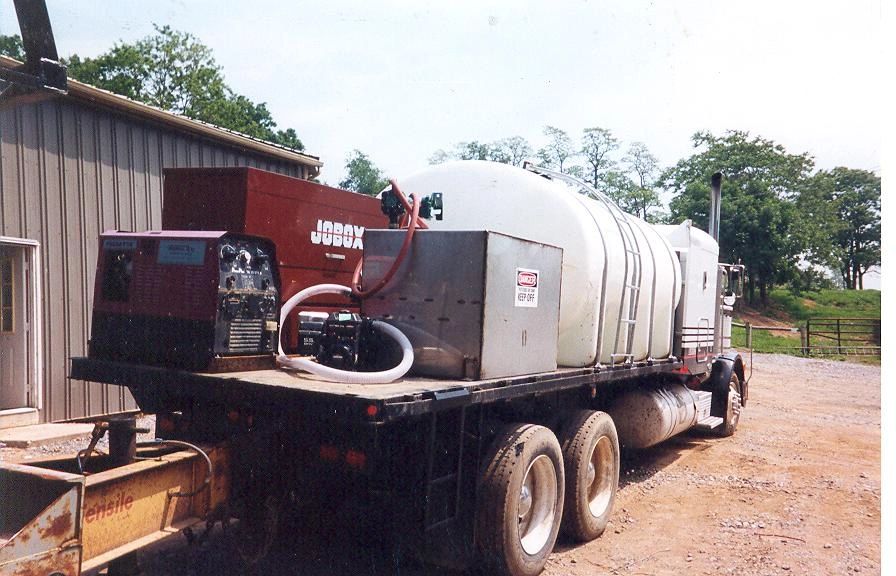

How does our sprayer work? 
We use a row crop sprayer that sprays from the left and right side of the machine, giving an average of 60 feet of coverage. The air speed coming out of the fans reaches 120 mph.

Our tank hold 450 gallons and can spray approximately 18 acres. On a good day we can do 100 acres.

We use a Raven 440 that calculates our volume per acre to our speed, allowing us to accurately apply the chemicals.

Our tracks are covered with nozzles mounted on the back of the machine.

For guidance, we use GPS that is capable of mapping, guiding, and calculating acreages.
__________________________________________________________________________________________________________
What a typical spray job looks like:

A typical fern application one year out.
 Mile-a-minute after treatment
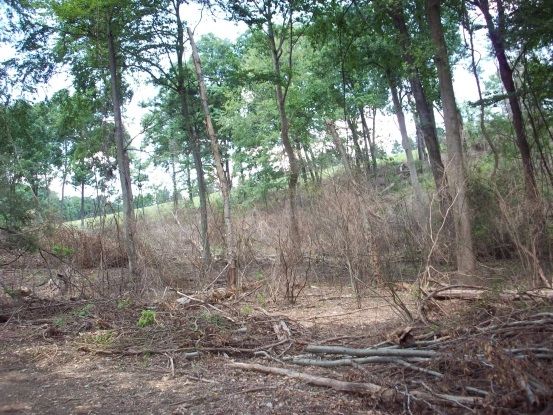 Spice bush, the spring following application.
 Hillside application; fern, beech brush
_______________________________________________________
Herbicide Results

Cherry seedling coming through fern mat.

Poplar regen – one full growing season

Poplar and ailanthus regen

Cherry regeneration – first year.
________________________________________________________________________________
Robert Vanderbosch
J & R Forestry, Inc.
2721 Maytown Rd
Marietta, PA 17547
Phone: 717-341-4414
Email: gvspray@gmail.com
Understory Herbiciding is a controlled burn down using chemicals to kill or control undesirable vegetation within 15 feet of the forest floor.
